
Your Local Mortgage Lender
Located in Southlake, Texas
Personalized Mortgage Experience
David White offers personalized service and loan options you'll love. We shop multiple lenders to find the best rate and product for you, getting you into your dream home faster.
With wholesale interest rates and cutting-edge technology, we make the mortgage process seamless. Trust the experts who focus solely on mortgages. Support your local community and experience elite client service.
Let us help you achieve your homeownership dreams!
The Home Loan Process
Mortgage Pre-Approval
Get pre-approved from one of our Loan Officers to see how much you can afford.
House Shopping
Work with a trusted Real Estate Agent to find a home you would like to move into.
Loan Application
Complete your home loan application to get the lending process started.
Don't take my word for it
Mortgage Programs
Experience the best mortgage experience located in Southlake, Texas.
Home Loan Options
Our experienced mortgage advisors will walk you through the best mortgage loan program that will fit your specific scenario.
Conventional Home Loans.
FHA Home Loans.
USDA Home Loans.
VA Home Loans.
Frequently Asked Questions
How often can I refinance my mortgage?
There is no limit to the number of times you can refinance. However, you must qualify every time you apply and there will be costs associated with closing the loan each time.
Can I buy a home if I do not have money for a down payment?
Yes! There are a number of bond programs that offer low or no down payment financing options.
How do I know which mortgage is right for me?
The key to choosing the right mortgage is to understand the range of options and features available to you, as well as your budget, circumstances, and goals. Our licensed mortgage professionals are here to help you navigate that process. The more you know, the more comfortable and confident you will be choosing the best option for you and your family.
How long will the loan process take?
The Truth in Lending Act (TILA) does not permit a lender to close a loan until at least seven (7) business days have passed from the date your application was received. A typical home loan takes 30 days, as a number of third-party services such as appraisals, title work, and credit are required in conjunction with the mortgage process. Once you familiarize your Loan Officer with the details of your specific loan scenario, they will be able to provide you with a more specific timeline.
Will I qualify for a home loan?
The only way to find out is to speak with a qualified mortgage professional. Our Loan Officers have helped numerous clients who didn’t know if they could qualify to become home owners. We take the time to understand your financial situation and long-term financial goals, and then match you with the loan program that best fits your needs. Your approval for a loan may also largely depend on the price of the home you are financing. Getting pre-qualified prior to beginning your home search can give you an idea of what you may be able to afford.
Why do people refinance their mortgages?
Homeowners typically refinance to save money, either by obtaining a lower interest rate or by reducing the term of their loan. Refinancing is also a way to convert an adjustable loan to a fixed loan or to consolidate debts.
How much money will I have to pay upfront to buy a home?
This question does not have a simple, one-size-fits-all answer. The exact amount will depend on the price of the home you buy as well the type of mortgage financing you choose. Depending on your loan program, your down payment could be as much as 20% of the home’s price or as little as 3%, while some loans require no down payment at all.
Can I get a mortgage after bankruptcy?
You may still qualify for a home loan even if you have experienced a bankruptcy. The best way to find out if you qualify is to talk with a Loan Officer to discuss your options. Be sure to bring all paperwork regarding your bankruptcy so your Loan Officer can find the program that best fits your situation.
Should I lock my interest rate now, or wait until we are closer to our closing?
Interest rates fluctuate all day, every day. If an interest rate is good, it may be in your best interest to lock now. If you wait, you run the risk of an increase in rates later. If you are concerned that rates may go down after you lock, contact your Loan Officer to discuss your options. Some programs allow you to lock for an extended period and choose to lower your rate should a better one become available.
Most Recent Blog Updates
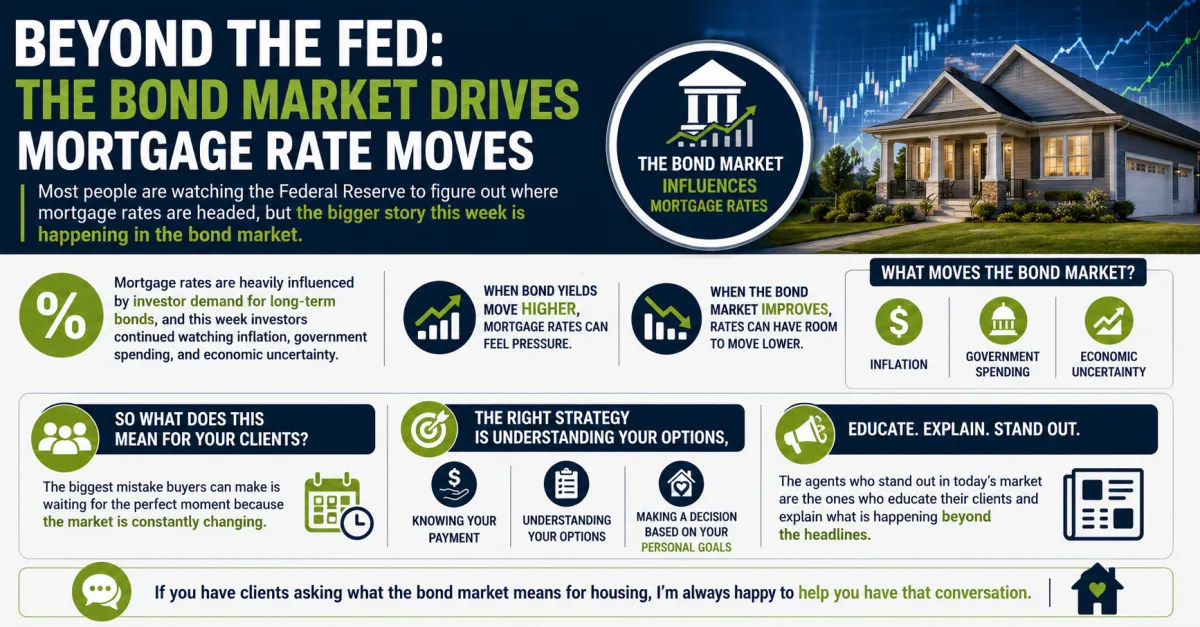
The Bond Market Is Driving Mortgage Rates More Than the Fed Right Now and Here Is What That Means
The Bigger Story That Most Buyers and Agents Are Missing
Most people watching the Federal Reserve for clues about where mortgage rates are headed are looking at the right institution but the wrong mechanism. The bigger story this week is happening in the bond market and understanding the distinction changes how buyers and their agents should be thinking about timing and strategy.
Why the Bond Market Matters More Than the Fed for Mortgage Rates
Mortgage rates are heavily influenced by investor demand for long-term bonds rather than by the Federal Reserve's overnight lending rate directly. When investors are concerned about inflation, government spending, and economic uncertainty they demand higher yields on the long-term bonds they hold. When bond yields move higher mortgage rates feel upward pressure. When the bond market improves and yields come down rates have room to move lower.
As David White explains the Fed sets one rate. The bond market determines another. Buyers and agents who are following Fed meeting schedules and waiting for rate cut announcements may be watching the wrong signal while the actual mechanism driving their mortgage rate moves in a different direction.
This week investors continued evaluating inflation data, the trajectory of government spending, and broader economic uncertainty. Those factors are the real drivers of where rates land day to day and week to week and they can move independently of what the Federal Reserve says or does at any given meeting.
What This Actually Means for Buyers Right Now
The practical takeaway for buyers is the same one that holds regardless of whether it is the Fed or the bond market generating the headlines. The biggest mistake buyers make is waiting for the perfect moment because the market is constantly changing.
A rate that looks favorable today can shift by the time a buyer finishes their home search. A rate that looks unfavorable today can improve before a buyer who starts the process now reaches the closing table. Nobody times the rate market perfectly and the buyers who succeed are not the ones who got the best rate on a specific day. They are the ones who understood their options, knew their comfortable payment, and made a decision based on their personal goals rather than waiting for a market signal that may or may not arrive on the schedule they were hoping for.
Where Agents Can Stand Out Right Now
The agents who stand out in today's market are the ones who educate their clients about what is actually happening beyond the headlines. Buyers who understand why bond yields affect their mortgage rate and why waiting for Fed announcements is not the same as waiting for rate improvement are buyers who can make confident decisions with full information rather than anxious ones based on incomplete understanding.
David White is always happy to help agents have that conversation with their clients. If you have buyers asking what the bond market means for their purchasing situation reach out and let's talk through it together.
Sources
FederalReserve.gov
TreasuryDirect.gov
MortgageNewsDaily.com
BankRate.com
Investopedia.com

Mortgage Calculator
See your total mortgage payments using the tool below.
| Year | Interest | Principal | Balance |
|---|

Important Pages
Terms of Service
Privacy Policy
Accessibility Assistance
Quick Links
Programs
Blogs
About Us
